A soap opera is "A drama, typically performed as a serial on daytime television or radio, characterized by stock characters and situations, sentimentality, and melodrama."
The term soap opera, often referred to as just a "soap", stems from dramatic serials broadcast on the radio in the 1930's, such as "Procter and Gamble", "Colgate-Palmolive" and "Lever Brothers". "Clara, Lu and Em" was the first of these soaps to debut on the airwaves in 1931.They were created to replicated the over the fence gossip by women in terreced back to back houses. These soaps were usually quite short, 10-15 minutes normally. They provided perfect background noise while a women worked around the house and almost always ended on a cliff-hanger of some sort. These broadcasts were sponsored and sometimes produced by various soap manufacturers. This meant that the original target audience for soaps was women, in particular, house wives. This also led to the genre being coined as a soap.
By the time World War 2 began, there were 64 soaps airing on the radio in America, showing how soaps were becoming prominent around the world.
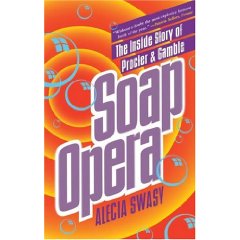
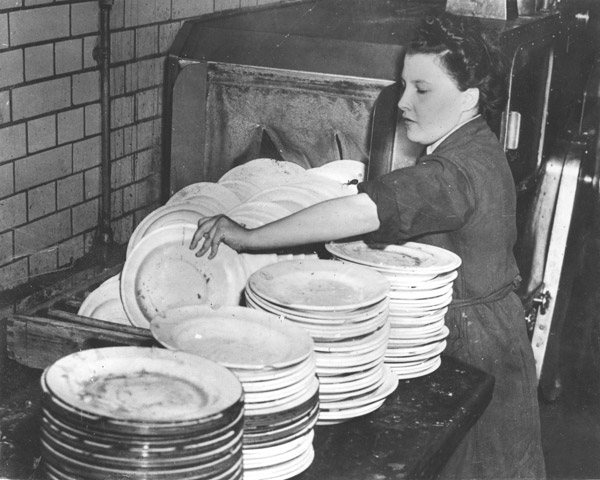 The Target audience for the first soaps, housewives.
These kind of serials first started appearing on television in 1950. The first soap actually appeared on T.V in 1947, which was "Faraway Hill." However this only ran for a few months, and was very low budget.
Soaps however kept running on the radio as well as television, and in the case of The Archers is still running. The Archers is now on BBC4, and has been running since 1951, making it the longest running British radio soap. The Archers still attracts roughly 5 million listeners and has now made over 15,000 episodes.
The first British soap was Coronation Street, which was first aired on the 9th of December, 1960. Coronation Street, or "Corrie" as it is colloquially known, was broadcast on ITV and remains there today, 49 years later. It is now the longest running televised soap opera in the world. Although it struggled at first, with only 13 episodes originally commissioned, the British public were drawn to Corrie for its down to earth characters and real life plotlines. However, by 1964, Corries boasted over 20 millions regular viewers.
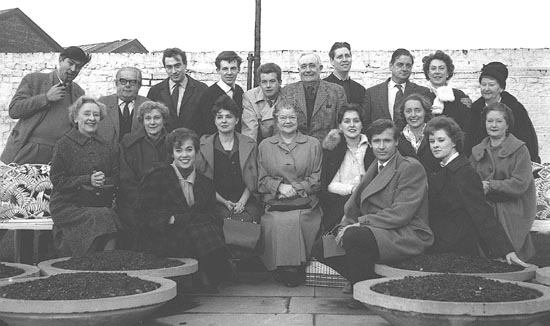
The Original Corrie cast.
Other early 1960's soaps were not greatly received and were filmed on very small budgets. Consequentially, most of these soaps, including "The Newcomers", "199 Park Lane" and "Compact" have almost completely disappeared from the archives.
Crossroads was Corries original soap rival. Also run on ITV, it began in 1964. It was reasonably popular even though it was of much poorer standard than Corrie. The poor acting and filming led it to be cancelled in 1988. An attempt to revive the show was made in 2001, but this failed again and the show was finally axed forever in 2003.
Emmerdale began in 1972 in a daytime slot, in rural Yorkshire. Originally named Emmerdale Farm, it was the main rival to Coronation Street, and with growing viewing figures it was moved to a prime time slot in the 1980's.
Dallas was an American soap. Although a lot glossier and happier than its British counterparts, it helped revive the soap opera and caused a rise in popularity in the genre. Dallas ran from 1978 - 1991.
Channel 4 was launched in 1982 and with it came Brookside. Brookside, based in Liverpool, re-defined the face of soap opera over the next year with its new ideas, storylines and characters that not only provided entertainment, but it also questioned certain social issues, forcing the audience to look at itself more than any soap had done beforehand.
Eastenders made its television debut in February 1985 and was an instant success, with over 17 millions people tuning in for the first episode. Eastenders 1986 Christmas episode was the highest-rated UK soap opera episode ever, with 30.15 million viewers.
Another soap which appeared in 1985 was Australian soap Neighbours. It was centred around a younger audience, so it was revolutionary to the soap genre, as its target audience wasnt house-wives and their husbands, but a younger audience. Neighbours prompted many other soaps to aim at a younger audience, most notably fellow Australian soap Home and Away and Hollyoaks.
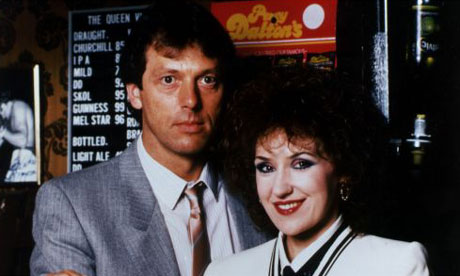
Angie and Den Watts, two pivotal characters in the 1986 Eastenders Christmas special.
Eastenders and Coronation Street, seen as the two biggest and most popular soap operas, were put up against one another in 1994 when they were scheduled at the same time. Coronation Street came out on top, and ever since, with the exception of hour long specials, the two don't clash with scheduling. For the past 10-15 years, Coronation Street and Eastenders have been the undisputed best British soaps.
As the 1990's drew in, the soap opera genre grew to become the leading television genre in Britain. However, a new soap still had to work hard to become an established programme. A good example of this was BBC's Eldorado which began in 1992 but only managed to survive a year.
In 1995, Channel 4 introduced the first soap geared mainly at a younger audience in Hollyoaks. Hollyoaks, along with soaps like Emmerdale and Neighbours, are considered to be Britain's 2nd tier of soaps, after Eastenders and Coronation Street.
Since 2000 new soap operas have come to the screen. Daytime drama Doctors began in 2000, appearing before Neighbours on BBC1. In 2002 BBC Scotland launched River City. River City proved popular and effectively replaced High Road when it was cancelled in 2003. The long-running Brookside ended in November 2003 after 21 years on air, leaving Hollyoaks as Channel 4's big soap.
Similarly to Eldorado, ITV's Night and Day began in 2001 and was cancelled in 2003.
Family Affairs was another soap to be cancelled in the 2000's, even though there was a revamp of the show and they won there first award in 2004. However, it was still axed in 2005.
In 2004, BBC created a radio soap opera for the BBC Asian Network called Silver Street.
More recently, soaps have become more of a commercial product as well as a T.V. programme. Things like DVD's and calendars have become common place for a soap opera, meaning the money involved is much greater than it originally was.

An example of one of the Hollyoaks calendars, a great commercial opportunity for the soap.
Soap operas have continued to grow and develop, with more intricate and controversial storylines. Soaps have come and go, and it is hard for a soap to establish itself. However long running soaps like Eastenders and Coronation Street look like they will always have a place on British television.
